
Customer Service Revolution: The Top 10 KPIs for Customer Service in 2025 while using AlloIntelligence, AlloBot and AlloReview
August 25, 2025 · 4 minutes of reading · Written by Armela
The Future of Customer Relationship Management
In 2025, businesses are leveraging cutting-edge artificial intelligence (AI) and automation technologies to revolutionize customer interactions. To stay competitive and maximize the potential of these innovative tools understanding and tracking key performance indicators (KPIs) is crucial.
The 10 Critical Customer Service KPIs Every Business Needs to Monitor
1. Customer Effort Score (CES): Simplifying Customer Interactions
The Customer Effort Score measures how easily customers can resolve their problems. Calculated on a scale of 1 to 5, this KPI is a powerful predictor of customer loyalty.
Key Insight:
- 96% of customers reporting low effort are likely to repurchase
- Only 9% of customers experiencing high effort remain loyal
2025 Trend: As highlighted by McKinsey AI-powered chatbots and callbots will dramatically reduce customer effort by providing instant, efficient responses.
2. Average Handling Time (AHT): Efficiency in Customer Support
Average Handling Time (AHT) tracks how long it takes to resolve a customer request. AI and automation tools like speech analytics are game-changers in reducing processing times by:
- Automatically routing customers to the most qualified agents
- Providing real-time suggestions to agents during interactions
- Identifying and resolving recurring delays in customer service
- Using predictive analytics to anticipate customer needs
- Automating routine tasks and responses for faster service
3. Call Answer Rate (CAR): Ensuring No Customer Goes Unanswered
Call Answer Rate represents the percentage of incoming calls successfully responded to within a specified timeframe. Predictive AI algorithms help:
- Anticipate call volumes
- Automatically allocate available agents
- Implement automated response systems
While achieving 100% CAR can be challenging in certain industries, AlloBot offer a solution by handling overflow calls 24/7, ensuring every customer receives a response even during peak periods or after hours.
4. First Contact Resolution (FCR): Solving Problems Immediately
First Contact Resolution measures the proportion of requests solved during the initial interaction. Benefits include:
- Reduced operational costs
- Improved customer satisfaction
- More efficient support processes
Research Finding: A 1% increase in FCR can reduce operational costs by 1%.
How to measure it?
1. Data Collection
Gather data from all customer service channels (phone, chat, email, etc.) for a specified period.
- Example: Over one month, your company receives 1,000 customer inquiries.
2. Identify Resolved Cases
Determine how many inquiries were resolved during the first contact.
- Example: Out of 1,000 inquiries, 800 were resolved on the first interaction.
3. Calculate the FCR
Use the formula:
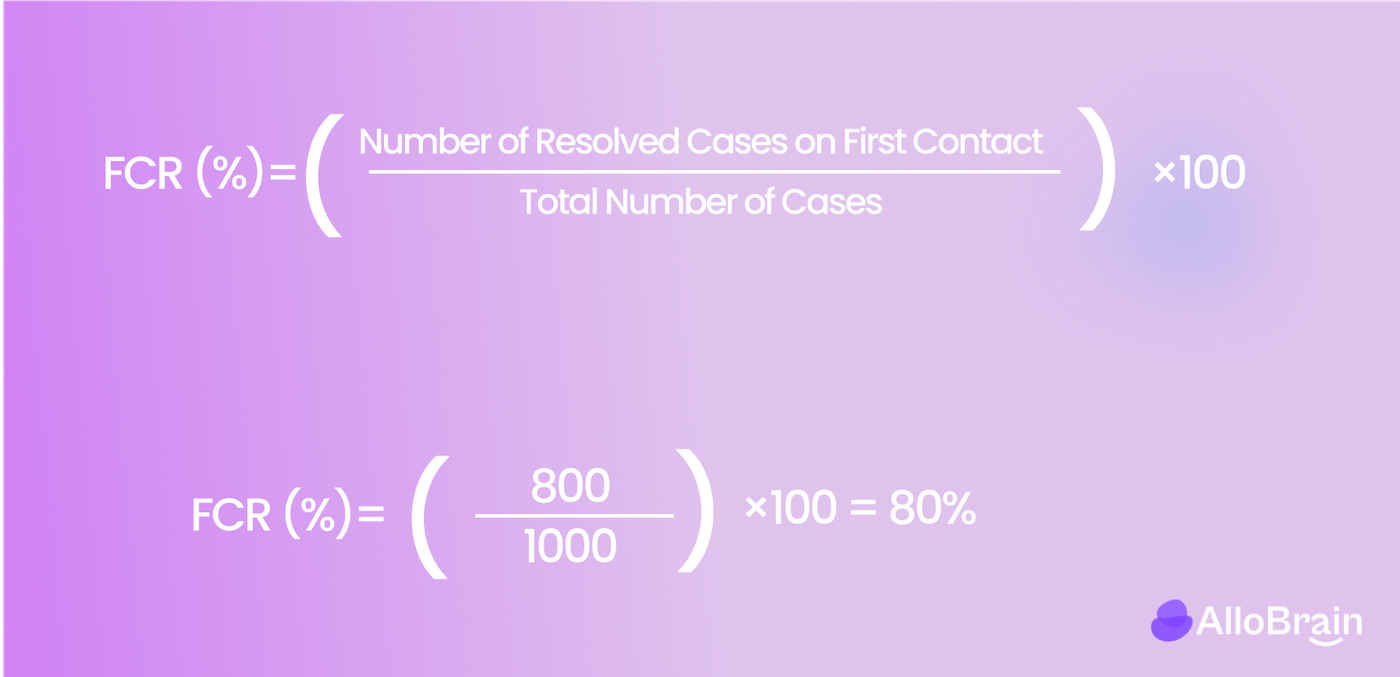
Speech analytics solutions like AlloIntelligence provide automated tracking of resolution rates across all channels, giving you accurate, real-time FCR metrics without manual effort.
5. Customer Retention Rate (CRR): Building Long-Term Loyalty
Customer Retention Rate tracks the percentage of customers retained over a specific period. The stakes are high:
- Acquiring a new customer costs 5x more than retaining an existing one
- A 5% increase in retention can boost profits by 25-95%
2025 Prediction: Predictive AI will help identify at-risk customers for targeted interventions, a strategy endorsed by both Harvard Business Review and McKinsey
6. Churn Rate: Preventing Customer Loss
Churn Rate calculates the percentage of customers leaving your business. Advanced tools like speech analytics can:
- Detect early warning signs of potential churn
- Identify negative emotional signals
- Analyze frequent complaints
7. Customer Satisfaction Score (CSAT): Measuring Direct Feedback
CSAT evaluates customer satisfaction after interactions, typically through a simple 1-5 or 1-10 scale.
Impact Stat: Based on our customers feedback, optimizing CSAT by one point increases revenues by 2.5%
With AlloReview's AI analyzing voice feedback, businesses gain insights 5 times richer than written surveys, enabling better understanding of customer satisfaction and more targeted improvements to boost CSAT scores.
8. Service Quality (QoS): Evaluating Comprehensive Performance
AlloIntelligence's Quality Score module automates QA across all channels with AI analysis and customizable scoring criteria. This ensures consistent quality standards while cutting QA costs by 40%, enabling real-time coaching and improvement insights.
Service Quality is assessed through customer surveys measuring:
- Agent responsiveness
- Courtesy
- Competence
AI-driven tools enable real-time performance analysis and continuous improvement.
9. Net Promoter Score (NPS): Measuring Customer Loyalty and Advocacy
NPS measures how likely customers are to recommend your business on a scale of 0-10. It segments customers into Promoters (9-10), Passives (7-8), and Detractors (0-6).
By leveraging generative AI, companies create personalized interactions that boost recommendation rates. This includes:
- Tailored follow-up communications based on specific customer feedback
- Proactive issue resolution before problems escalate
- Customized rewards and recognition for promoters
- Automated analysis of customer sentiment to identify improvement areas
10. Cost per Interaction: Financial Efficiency in Customer Service
This KPI measures the financial effectiveness of customer service operations.
Efficiency Insight: Deloitte suggests that intelligent automation can reduce interaction costs by 20-40%.
Conclusion: Balancing Technology and Human Touch in 2025
Success in customer relationship management will hinge on striking the perfect balance between technological innovation and human interaction. By carefully tracking these 10 KPIs and integrating AI, automation, and predictive analytics, businesses can deliver seamless, personalized, and competitive customer experiences.
Key Takeaway: The future of customer service is intelligent, adaptive, and customer-centric.
AlloBrain frequently asked questions
What is AlloBrain and how does it differ from traditional AI for customer service?
One platform for the whole chain: AI agents and live assistance during the conversation, quality monitoring and voice of customer after it. Every capability feeds the others.
How does AlloBrain’s voice recognition work with multiple languages and dialects?
180+ languages including 16 Arabic dialects, from deep-learning models trained on millions of hours of conversation.
How can large enterprises reduce costs with AlloBrain?
Automates up to 70% of repetitive interactions, cuts average processing time by 60%, and replaces manual audits with 100% monitoring. Typical 40% operational cost decrease in year one.
How long does deployment take compared to traditional systems?
Weeks rather than 6 to 12 months. Voice feedback can be operational in days.
Which industries benefit most?
High-volume sectors: e-commerce, financial services, telecommunications, healthcare, and tourism.